








BULGARIAN
MUSIC
ECOSYSTEM

THE MUSIC RIGHTS ECONOMY

The first-of-its-kind analytical report focusing on music copyright and neighbouring rights, as well as the interaction between creators, performers, producers, publishers and collective management organizations (CMOs).
BAMP - Background
BAMP - Background
Maria Ilieva

Introduction

This report aims to provide a fresh view of the Bulgarian music ecosystem with a focus on the music rights industry – those earning most of their revenue from exploiting copyright or neighbouring rights, including artists, creators, producers (owners of master rights), distributors, Collective Management Organisations (CMOs), and music publishers. This report evokes the ecosystem concept to describe the complex and interconnected nature of the music sector. It’s useful to better make sense of the diverse actors, their multi-layered motivations, interactions, and environment in context. Such context-sensitive analysis can help identify the necessary leverage points for effective policy making and collective action.

The data sources used in this report include: data collected by the Bulgarian Association of Music Producers (BAMP), data collected by the CMOs and published in their annual reports, and national statistics gathered in Bulgaria by the National Statistical Institute (NSI). While there are challenges with combining all these sources, to some degree, a more comprehensive overview of the music economy is possible. For the contextual understanding, the report relies on expert interviews as well as available reports, policy documents and other written sources.
BAMP - BackgroundBAMP - BackgroundMaria Ilieva
BAMP - Background

What is a music ecosystem?

BAMP - Background
A recent European Commission paper defined the music ecosystem as a “network of music sector actors, their environment, their interdependencies and interactions through the production, distribution and consumption of music so that value is created for the system itself, and for
the systems it is part of”. Beyond purely
economic data, applying this framework
aims to provide contextual insights
about key actors and their
interactions.
Applying the ecosystem's focus on actor complexity is crucial here. Terms like "artist" and "producer" are broad categories. In the context of rights, an "artist" (often the public-facing persona) might simultaneously be an author (songwriter, composer), performer, and even the producer (master rights owner) of their own recordings. These different roles involve distinct rights (author's, performer's, producer's), and understanding these combinations is vital when analysing, for example, artist success in the digital era.
BAMP - Background

What is a music ecosystem?

BAMP - Background
A recent European Commission paper defined the music ecosystem as a “network of music sector actors, their environment, their interdependencies and interactions through the production, distribution and consumption of music so that value is created for the system itself, and for the systems it is part of”. Beyond purely economic data, applying this framework aims to provide contextual insights about key actors and their interactions.
Applying the ecosystem's focus on actor complexity is crucial here. Terms like "artist" and "producer" are broad categories. In the context of rights, an "artist" (often the public-facing persona) might simultaneously be an author (songwriter, composer), performer, and even the producer (master rights owner) of their own recordings. These different roles involve distinct rights (author's, performer's, producer's), and understanding these combinations is vital when analysing, for example, artist success in the digital era.

The Bulgarian music ecosystem in numbers

The total music rights revenue in Bulgaria
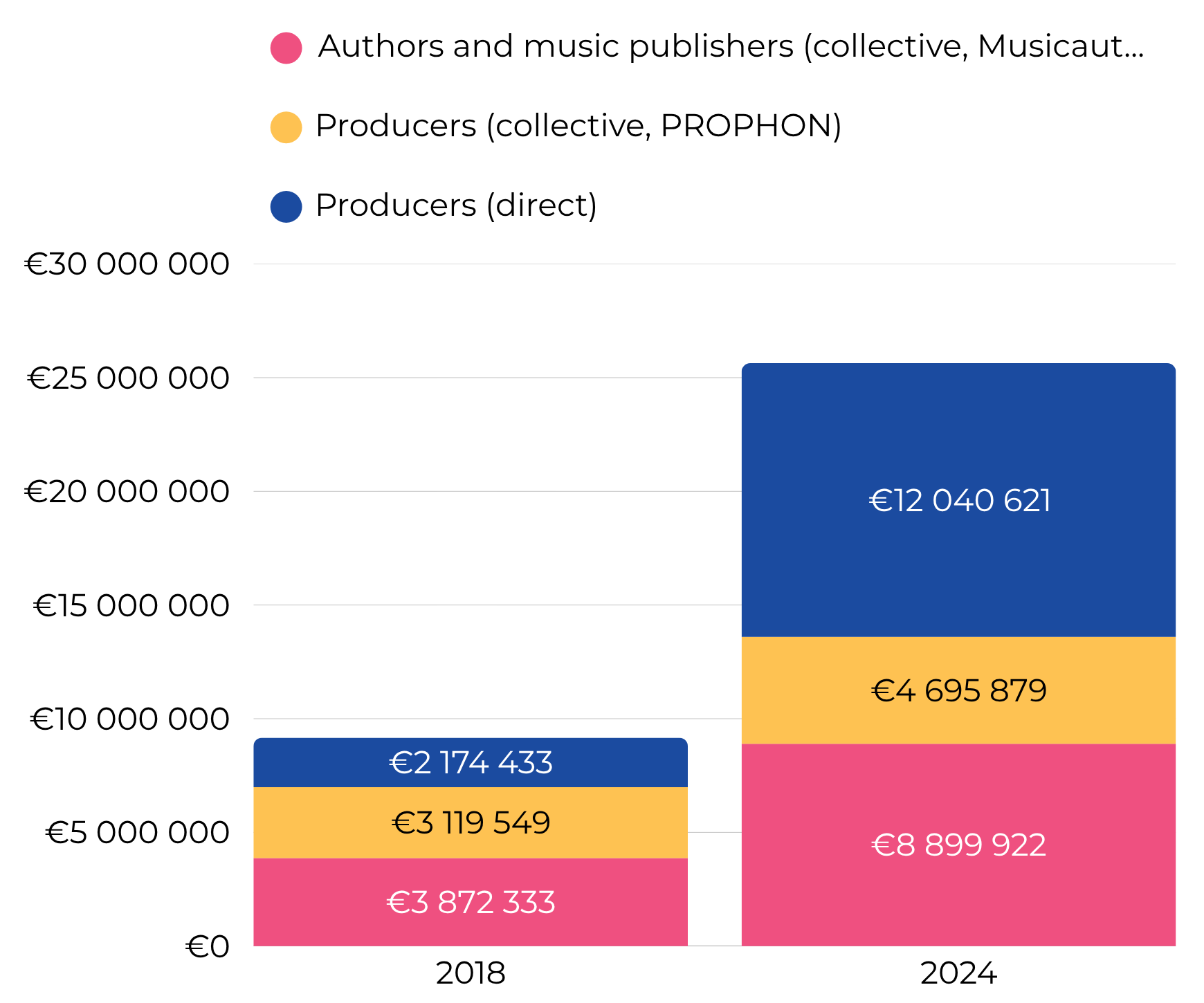
The total music rights revenue in Bulgaria has grown significantly, from more than €9.2 mln in 2018 to €25.6 mln in 2024.

This represents a total growth of 180% and CAGR of 18.7%.

This growth has been mostly driven by producers’ direct revenues (up 454% over the past 7 years), making up 47% of the total music rights revenues in 2024 (up from 23,7% share in 2018).
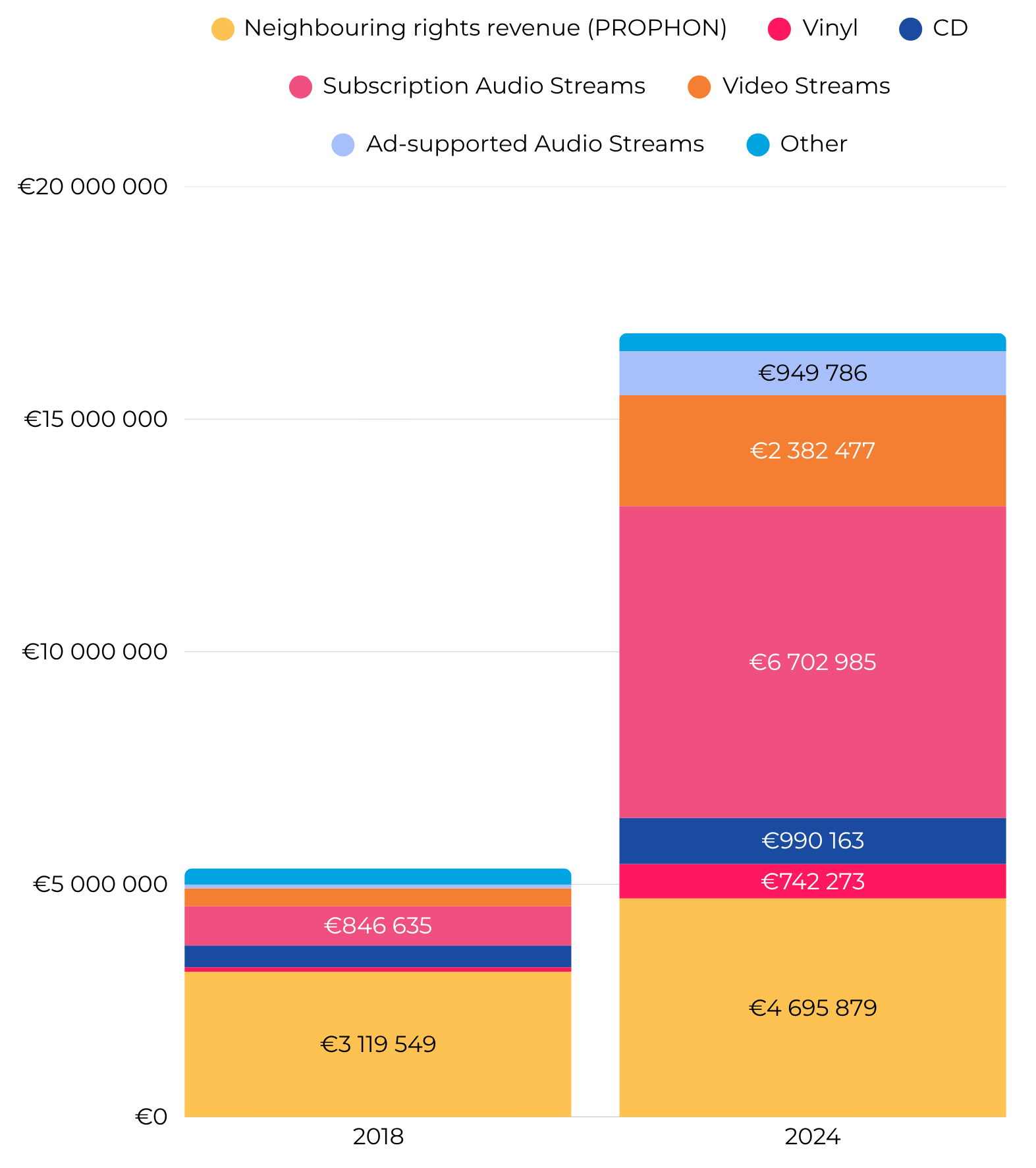
The growth of recorded music revenue for producers over the past 7 years has been significant – from €5.4 mln to €16.8 mln in total, with a total growth of 215% and CAGR of 21.1%.

The main source of this growth is revenue from digital platforms, including subscription and ad-supported audio streams as well as video streams. In total, digital revenue across these three sources has grown from €1.3 mln in 2018 to €10 mln in 2024, a staggering 600% total growth over the seven years.
The growth of recorded music revenue for producers
The neighbouring rights revenue collected by PROPHON
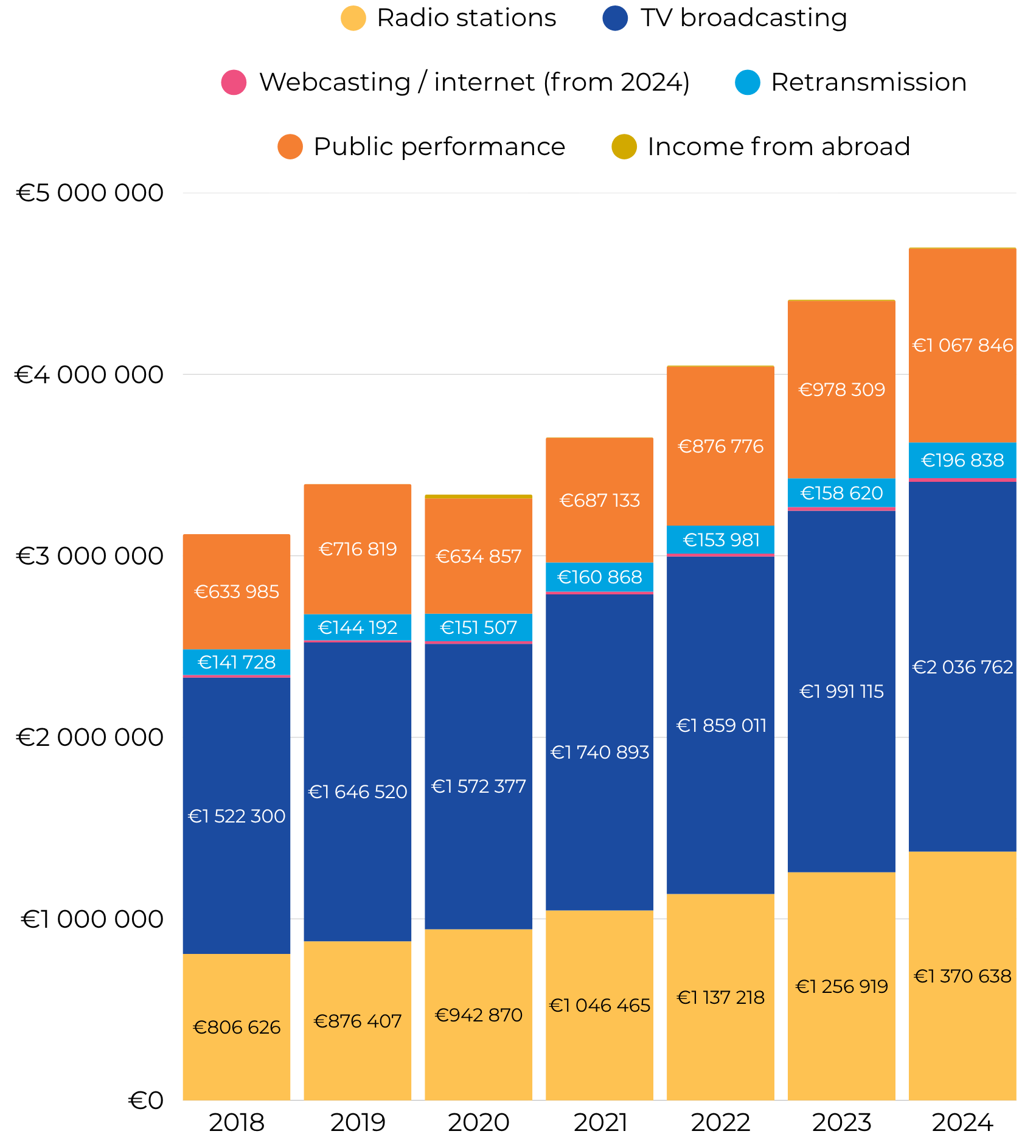
The neighbouring rights revenue collected by PROPHON for both producers and performers amounted to €4.7 mln in 2024.

The biggest source of revenue is TV broadcasting (43.4%, over €2 mln.), mainly from using recorded music in TV programmes. This is followed by radio (29.2%, €1.4 mln. in 2024). Public performance of recorded music makes up 22,8% of revenues and amounted to €1.7 million in 2024.
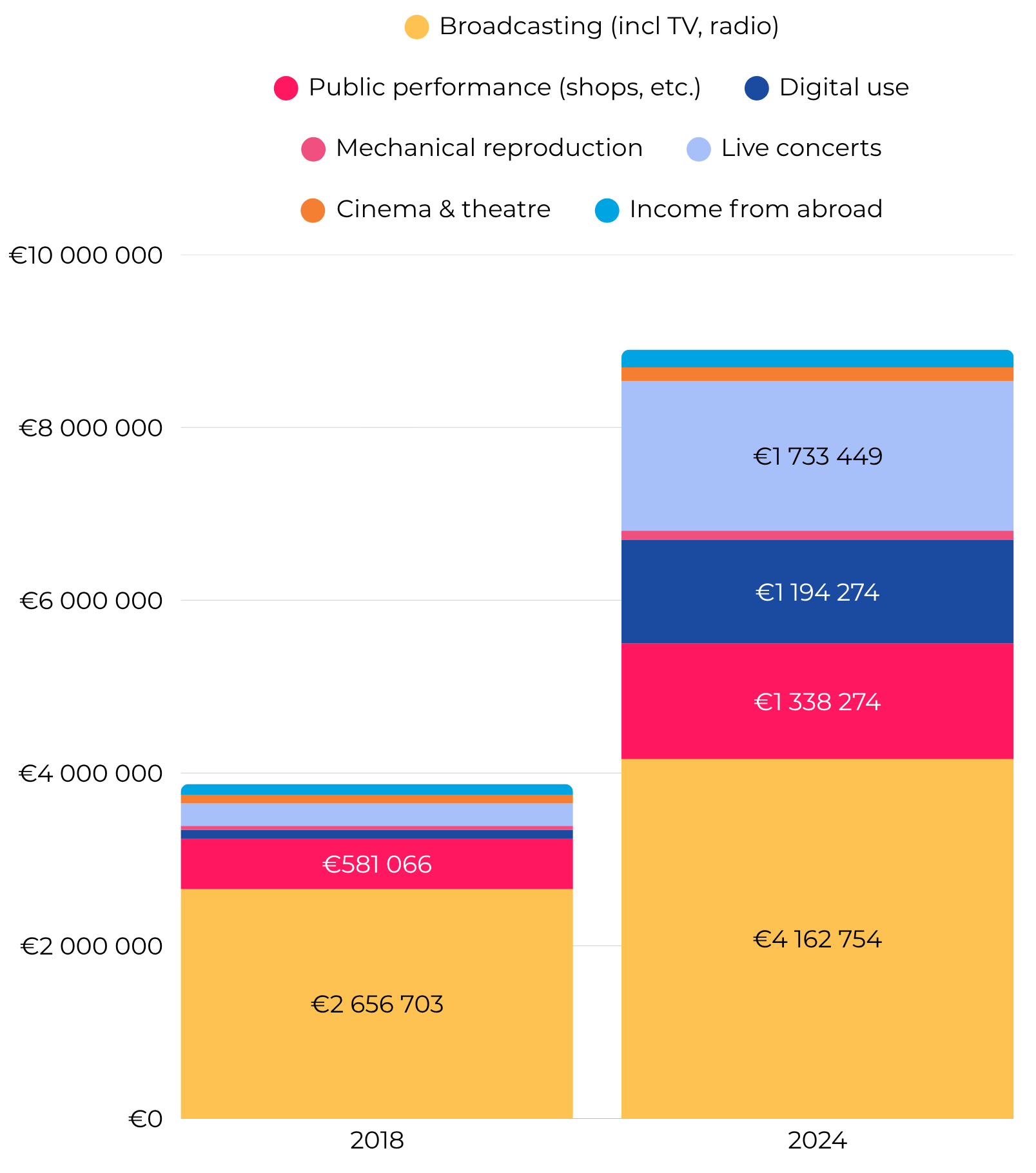
Тhe authors’ and music publishers’ revenues collected by Musicautor have grown nearly 130% for the last 7 years, reaching almost €8,9 mln.

The biggest segment is broadcasting, making up nearly half of the revenue collected by Musicautor in 2024, growing from €2.7 mln in 2018 to €4.2 mln in 2024. Other significant sources are public performance (€1.3 mln, 15% from the total revenue in 2024), live concerts (€1.7 mln, 19,5% from the total revenue in 2024) and digital use (€1.2 mln in 2024), with the latter segment having grown with a sharp increase in 2021.
Тhe authors’ and music publishers’ revenues collected by Musicautor

Growth potential

Growth potential
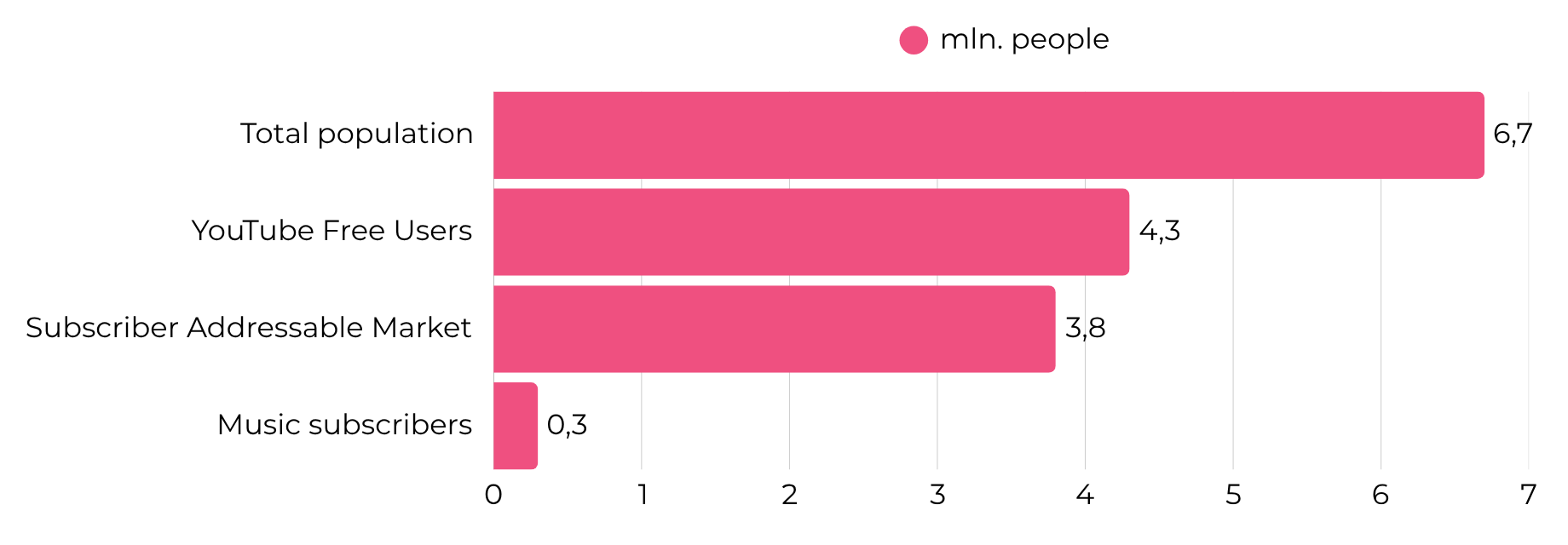
According to Will Page’s (former Chief Economist at Spotify) estimations about streaming platforms’ total addressable market (TAM) and the number of current users, there are currently only 300 000 subscribers in Bulgaria, compared to 4.3 million free YouTube users. Page estimates the Subscriber Addressable Market to be 3.8 million people, or 57% of the population (compared to the currently <5% actually attained), which, if fully realised, could produce approximately €42.4 mln revenue yearly.

Music consumption

Music scenes and genres

According to a recent survey, conducted by BAMP, the most popular genres in Bulgaria are pop (33%) , pop folk (33%), popular music from the 1960s-70s ("stage" music, 28%), rock (24%), and folk music (20%).

Ways and habits of listening

Preferences vary by demographics and regionality. A significant majority (88%) of Bulgarians aged 16-64 listen to music at least weekly, and nearly half (46%) listen daily, but many respondents admit they would give up listening to music if they had to pay. The most preferred locations to listen to music are at home and in the car, and from the radio and TV.
YouTube is a widely used platform, but only about a fifth use streaming services, with less than 5% paying for subscriptions. Digital piracy remains a significant issue, with BitTorrent sites being the primary method of accessing pirated music. This is seen as a challenge to the growth of paid legal music services.

Recommendations

for the Growth of the Bulgarian Music Industry

Recommendations

for the Growth of the Bulgarian Music Industry

Strengthen Copyright Implementation and Enforcement

Effective copyright protection and enforcement are fundamental to the economic viability of the music rights sector. To support market growth and development, it is essential to:

  • combat digital piracy,
  • improve public performance licensing
  • reform tariff-setting mechanisms

Much-needed legislative amendments and improved procedures are in the works – it is important that these be implemented as soon as possible.

Enhance Music Business Knowledge and Professional Skills

A stronger understanding of music business practices, copyright, and contract law is key to the professional development of all participants in the music ecosystem. To address current gaps, stakeholders should:

  • develop targeted educational resources
  • facilitate training and mentorship, and
  • promote dialogue and transparency.

These efforts will help individuals capitalise on opportunities, encourage new entries into the sector’s workforce, and foster trust within
the ecosystem.

Invest Strategically in Talent Development and New Bulgarian Repertoire

The long-term health and diversity of the Bulgarian music scene depend on sustained investment in nurturing artistic talent and supporting the creation of high-quality original music. To strengthen this area, it is important to:

  • increase funding for creation
  • support artist development pathways, and
  • review and optimise public funding.

These steps will help ensure that artists and labels across all genres have access to the resources they need.

Develop a Holistic Music Policy and Strategy

A national cultural strategy with a clear vision for music in Bulgaria is essential to avoid fragmented policies and missed opportunities. To achieve this, it is necessary to:

  • define a strategic vision for the Bulgarian music ecosystem with a more holistic, ecosystem-based approach
  • adopt a balanced policy scope, and
  • ensure a sustainable funding framework.

A commitment to data and monitoring will also support better decision-making and long-term planning. The state must act as a strategic enabler, supporting both culturally diverse grassroots scenes and a commercially viable music industry.

Support International Development and Music Export

Developing international career paths and business strategies is crucial for the growth and sustainability of Bulgarian artists and music labels. To strengthen this area, stakeholders should:

  • establish an export support structure,
  • provide targeted export funding, and
  • build international networks and capacity.

These actions will help Bulgarian music
reach new audiences and markets.

Promote the Value of Music and Combat Piracy

There is a significant cultural issue - the undervaluing of music and expecting it to be freely available, which is reflected in high levels of digital piracy. To address this, the industry should:

  • enhance value awareness campaigns,
  • engage artists and industry as advocates, and
  • target businesses on licensing.

While cultural change is complex, consistent communication and a broad-based coalition can strengthen the impact and support revenue generation across the sector.

Автор на доклада: Вирго Силамаа

Author of the report: Virgo Sillamaa

Virgo Sillamaa is a music policy and ecosystem researcher, educator and consultant from Estonia, currently based in Brussels. With 20+ years of experience in the music sector, he is currently the Research Coordinator of EMEE, European Music Exporters Exchange network, and a board member at the Estonian Authors’ Society.

Virgo is regularly engaged in project development and implementation, advising initiatives and organisations within the music ecosystem, such as coordinating research in the “Europe in Synch” and “Better Live” projects. He is a frequent lecturer and also gives guest lectures and workshops on music and cultural policy and international projects.